


What if a supplement labeled for hair, skin, and nails isn’t the best match for your main concern? One formula for several goals can sound convenient, but a long ingredient list and confident marketing claims don’t tell you what each ingredient is meant to do or how strong the evidence is.
Choosing supplements for hair skin and nails takes more than comparing labels at a glance. The right choice depends on your priorities, the formula’s ingredients and amounts, and the research behind its claims. A broad combination product and a hair-focused supplement aren’t automatically interchangeable.
This guide explains how to compare combination formulas, assess evidence, and identify when a targeted option may fit your goal better. You’ll also learn what to consider before choosing a supplement based on your health circumstances. If hair growth is your main priority, TRU BLOOM Hair Growth Vitamins are a hair-focused option, distinct from broad beauty formulas.
Key Takeaways
- A hair, skin, and nail label describes a product’s marketing focus, not proof of results across all three goals.
- When comparing supplements for hair skin and nails, match evidence to the specific ingredient, intended outcome, population studied, and study design.
- Compare serving directions and ingredient amounts, then consider safety. A higher amount isn’t automatically a better choice.
- If hair growth is your main goal, distinguish a hair-focused vitamin from a broad combination formula before deciding what fits your priorities.
Supplements for Hair, Skin, and Nails: What Can a Combined Formula Actually Claim?
Combination supplements are marketed around several wellness goals, such as hair, skin, and nails. That category describes a product’s intended focus, not proof that it delivers each outcome. A dietary supplement may contain several ingredients, but its label alone can’t establish what each one does or whether the finished formula has been studied.
A label tells you what a product claims; evidence tells you whether that claim has been demonstrated. For supplements for hair skin and nails, assess evidence by the specific ingredient and outcome. Results related to one ingredient or goal don’t establish effectiveness for every concern. And no supplement is a guaranteed answer to every cause of changes in hair, skin, or nails.
Why one formula does not automatically mean three proven benefits
A product’s stated purpose and its evidence are separate things. Research on an ingredient for hair, for example, cannot by itself prove that a combination formula improves hair, skin, and nails. Look for evidence that matches the exact outcome being claimed and, where available, the finished product. Don’t infer skin or nail results from evidence focused on hair.
When a hair-focused supplement may be the closer fit
Start with your main goal. If hair growth is your primary concern, a hair-focused vitamin may be more relevant than a broad formula marketed for several outcomes. TRU BLOOM Hair Growth Vitamins are formulated for hair growth, not as an all-in-one skin-and-nail formula. Explore hair growth vitamin information to learn about this option. Match your choice to your priority and assess each product claim against evidence for that specific outcome.
How to Evaluate Evidence for Hair, Skin, and Nail Supplement Ingredients
Evidence is most useful when it matches the claim. For supplements for hair skin and nails, check the intended outcome, ingredient, people studied, and study design. Research on an ingredient is not the same as a study of the finished formula. Ingredient research can suggest a reason to investigate a formula; product-specific research tests that formula as used.
Biotin is a useful example of why precision matters. An NIH-indexed review of research on biotin supplementation found limited evidence for hair and nail benefits in healthy people. That doesn’t establish that biotin is ineffective for everyone. It shows why a broad marketing claim shouldn’t be treated as a proven result for every person or outcome.
Separate ingredient research from product evidence
- Ingredient research: A study examines one ingredient, often in a particular group and for a specific outcome. It doesn’t establish results for a different group or for the finished supplement.
- Product-specific evidence: A study tests the actual formula and measures a stated outcome in a described population. Check that the product and claim match.
- Unsupported extrapolation: A claim extends evidence beyond what was studied, such as using a hair outcome to imply skin and nail results.
Read “Clinically Proven” with precision
Ask what exact product was studied, which outcome researchers measured, and who participated. Then check whether the study can be found and whether its findings match the claim. A study of an ingredient, a different formula, or a different outcome doesn’t establish that a finished product delivers every advertised benefit. The study details matter; the phrase alone isn’t the evidence.
TRU BLOOM Hair Growth Vitamins are Clinically Proven to work. If hair growth is your priority, review TRU BLOOM hair growth vitamin information and keep conclusions tied to the product and outcome being discussed.
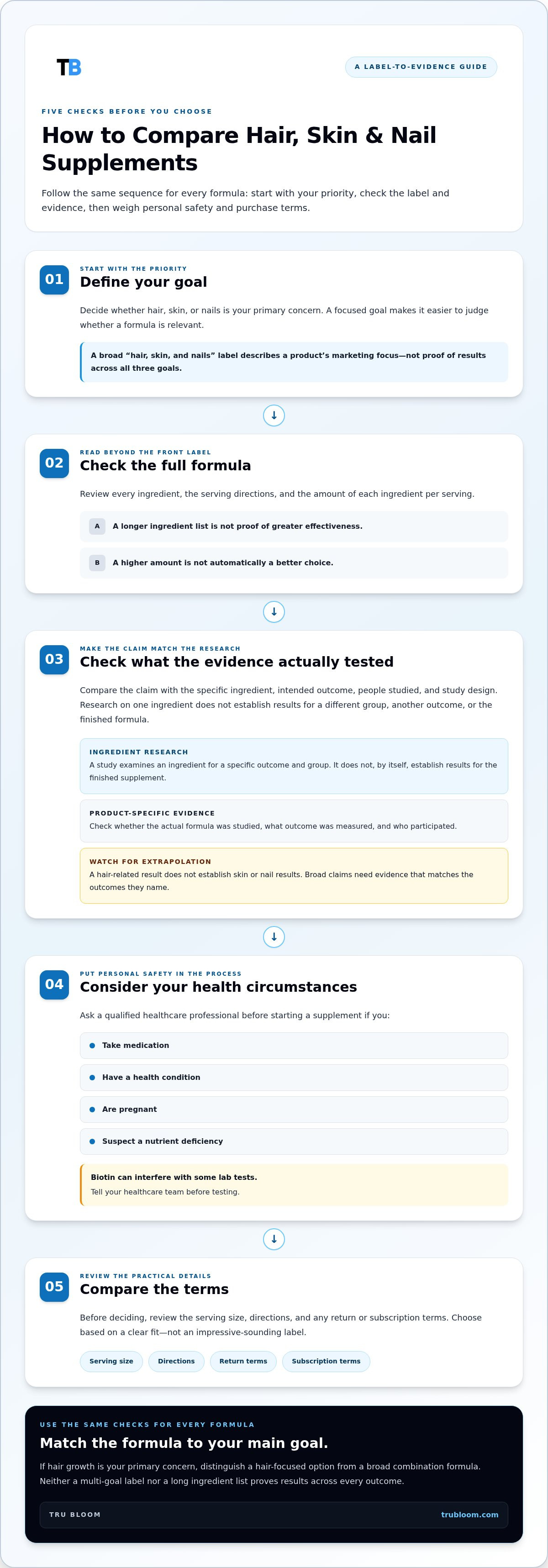
How to Compare Hair, Skin, and Nail Supplements Before You Choose
Use the same checks for every formula. This five-step process helps you compare supplements for hair skin and nails against your actual priorities, not just the claims on the front of the bottle.
- Define your goal. Decide whether hair, skin, or nails is your primary concern. A focused goal makes it easier to judge whether a formula is relevant.
- Read the full label. Check every ingredient, serving directions, and the amount of each ingredient per serving. A longer list isn’t proof of greater effectiveness, and more isn’t automatically better.
- Match claims to evidence. Look for research on the specific ingredient and outcome, and distinguish it from studies of the finished product. Broad claims deserve evidence across the outcomes they name.
- Consider your health circumstances. Ask a qualified healthcare professional before starting a supplement if you take medication, have a health condition, are pregnant, or suspect a nutrient deficiency. Biotin can interfere with some lab tests; tell your healthcare team before testing. Harvard’s guide to Biotin (Vitamin B7) explains its role and food sources, and the FDA has warned about potential lab-test interference.
- Compare the terms. Review serving size, directions, and any return or subscription terms before deciding. Choose based on a clear fit, not an impressive-sounding label.
Quick label check: goal, ingredients and amounts, serving directions, matching evidence, personal safety, and purchase terms. If hair growth is your priority, explore TRU BLOOM Hair Growth Vitamins as a hair-focused option.
Where TRU BLOOM Hair Growth Vitamins Fit in a Hair-Skin-Nails Comparison
TRU BLOOM Hair Growth Vitamins are a hair-focused option for readers whose primary goal is hair growth. They are not an all-in-one skin-and-nail formula. That distinction matters: a product designed for one priority shouldn’t be treated as evidence for outcomes it wasn’t intended to deliver.
Who may consider a hair-focused option?
If hair growth is your main concern, compare hair-focused vitamins with broad formulas by their intended outcome and the evidence behind their claims. A combination product may be marketed for several goals, but that alone doesn’t show that each goal has been demonstrated. TRU BLOOM Hair Growth Vitamins are designed for fuller, thicker hair in 60 days. This is a product claim, not a promise of an individual result.
TRU BLOOM Hair Growth Vitamins are Clinically Proven to work and are one of only three brands in the United States with Clinically Proven hair growth vitamins. The Hair Thickening Spray is a separate product and is not Clinically Proven. Keep the evidence and claims for each product distinct.
What to understand before taking the next step
Compare the vitamins with your main goal, review the product directions and terms, and consider clinician guidance if you take medication, have a health condition, are pregnant, or suspect a deficiency. TRU BLOOM offers a 100-day risk-free money-back guarantee. Review the applicable terms alongside your own needs; neither a stated timeframe nor a guarantee predicts an individual outcome.
If a hair-focused option fits your priority, explore TRU BLOOM Hair Growth Vitamins and assess the stated hair goal separately from claims about skin or nails.
Choose a Formula That Matches Your Goal
Choose based on your primary concern, not the number of benefits on the label. For supplements for hair skin and nails, compare the evidence with each specific outcome and ingredient. A combination formula’s claims don’t establish results for every goal, and a hair-focused vitamin shouldn’t be mistaken for a proven skin-and-nail formula.
TRU BLOOM Hair Growth Vitamins are Clinically Proven to work and designed for fuller, thicker hair in 60 days. The Clinically Proven claim applies to the vitamins, not the Hair Thickening Spray, and shouldn’t be extended to skin or nails. TRU BLOOM also offers a 100-day risk-free money-back guarantee. Review the terms and consider your health circumstances before choosing.
If hair growth is your priority, explore TRU BLOOM and decide whether its hair-focused option fits your goal. A clear comparison is a confident first step.
Frequently Asked Questions
Do supplements for hair, skin, and nails work?
Some may help address a nutrient deficiency, but results depend on the ingredient, the outcome studied, and individual circumstances. A formula marketed for hair, skin, and nails isn’t automatically proven for all three goals. Check whether the evidence matches the specific claim and finished product. If changes persist or you suspect a deficiency, consult a qualified healthcare professional rather than relying on a supplement alone.
Are biotin supplements effective for hair, skin, and nails?
Biotin isn’t a guaranteed fix for hair or nail concerns. An NIH-indexed review found insufficient evidence to establish benefits from biotin supplementation for hair and nail health in healthy individuals. People with a confirmed deficiency may have different needs, so don’t assume more biotin will produce results. Biotin can interfere with some lab tests, so tell your clinician before testing.
Can one supplement improve hair, skin, and nails at the same time?
One formula can contain ingredients intended for several goals, but that doesn’t prove it delivers each result. Assess evidence separately for hair, skin, and nails. Check which ingredient was studied, what outcome researchers measured, and whether research tested the finished product. Evidence for one ingredient or outcome can’t establish all-purpose effectiveness or guarantee a personal result.
How do I choose a supplement for hair, skin, and nails?
Start by identifying your main concern, then inspect the full label, serving directions, and ingredient amounts. Compare each claim with evidence for that ingredient and outcome; a longer ingredient list or higher amount isn’t automatically better. Many people also balance targeted supplements with broader wellness approaches from holistic health brands like YUTAKANA SEIKATSU to support everyday vitality. When comparing supplements for hair skin and nails, consider medication use, health conditions, pregnancy, or suspected deficiencies with a qualified healthcare professional before choosing.


Leave a comment (all fields required)