


Ashwagandha may help reduce stress-related hair loss, and early findings suggest it could affect hair thickness. The potential benefits of ashwagandha for hair include a possible reduction in shedding and changes in hair growth measures, but the clinical evidence is still limited. In one 75-day study, people using a topical ashwagandha root extract serum had a mean increase in hair thickness of 1.80 μm.
When shedding picks up or hair feels less dense, it’s natural to look for clear answers about the benefits of ashwagandha for hair. Stress may contribute to hair loss, and ashwagandha has been studied for its effects on stress. But one topical study cannot establish what oral supplements or at-home hair masks will do.
Here, you’ll learn how ashwagandha may relate to hair loss, scalp inflammation, dandruff, growth, and thickness, and what the available research can and cannot tell you. The key distinction is that promising early findings are not strong proof that ashwagandha reliably regrows hair.
Key Takeaways
- Distinguish research on stress relief from proof that ashwagandha directly regrows hair; they answer different questions.
- Keep scalp claims in perspective: potential effects on inflammation and dandruff don’t establish a reliable treatment.
- Compare study outcomes with the placebo results, not just the changes reported in the ashwagandha group.
- Use the evidence to set realistic expectations about growth and thickness, and understand why stronger clinical research matters.
Can Ashwagandha Help Treat or Slow Hair Loss?
Ashwagandha may affect stress-related shedding, but evidence does not establish it as a general hair-loss treatment. Findings about stress and small topical studies do not prove reliable regrowth for every cause of hair loss.
Stress, Cortisol, and Hair Loss
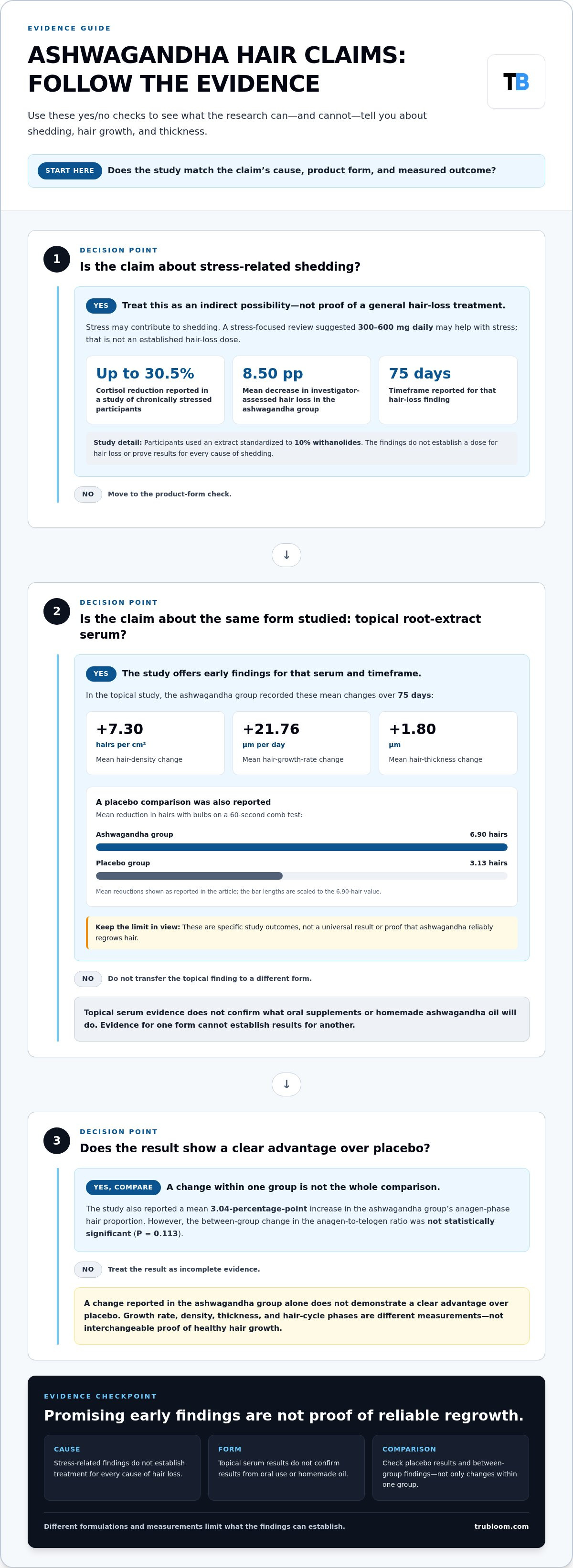
Stress-related hair loss is shedding associated with the body’s response to sustained stress, including changes in cortisol. Ashwagandha, or Withania somnifera, is an adaptogenic herb used in Ayurveda. A review suggested 300 to 600 milligrams daily may help with stress, while one study of chronically stressed participants used an extract standardized to 10% withanolides. The study reported cortisol reductions of up to 30.5%. In an ashwagandha group, investigator-assessed hair loss decreased by a mean of 8.50 percentage points after 75 days. That result is promising, but it doesn’t establish a dose for hair loss.
Possible Effects on Hair Loss and Alopecia
Alopecia describes hair loss, but its causes differ, so a stress-related effect can’t be assumed to apply to every type. One report found ashwagandha extract effective in reducing hair loss and promoting regrowth in people with telogen effluvium, a form associated with a shift in the hair-growth cycle. Potential benefits of ashwagandha for hair may therefore be indirect when stress is a contributing factor. Compared with treatments such as once-daily oral finasteride for male pattern hair loss, ashwagandha has less direct evidence for treating that specific condition. The 75-day findings also don’t establish how soon an individual will notice hair changes.
Topical Ashwagandha and Hair Oil
Topical ashwagandha and infused hair oil are different from oral supplements, and evidence for one form can’t confirm results from another. Some clinical research has examined topical ashwagandha root-extract serum, but the evidence does not establish that it prevents hair loss. The ashwagandha group had a mean reduction of 6.90 hairs with bulbs on a 60-second comb test; the placebo group’s mean reduction was 3.13 hairs. These results don’t establish that homemade ashwagandha oil prevents hair loss. For oral use, a recommended dose specifically for hair benefits hasn’t been established; the studied stress dose isn’t a hair-loss prescription. According to the National Center for Complementary and Integrative Health, ashwagandha may be safe for up to 3 months at a time. Side effects and interactions are relevant risks: people with health concerns or taking medication should consult a healthcare provider before starting it.
Scalp inflammation and dandruff
Ashwagandha’s potential anti-inflammatory properties may soothe scalp irritation or reduce dandruff, but that possibility is not proof that it treats dandruff. Flakes can have different triggers, and redness, itching, and flaking can overlap. A dry, tight scalp and persistent irritated patches, for example, are not automatically the same problem. Hair care works best when it addresses the scalp concern, not just the visible flakes.
Inflammation is the body’s response to irritation, and an active response can make the scalp uncomfortable. Ashwagandha is discussed for potential anti-inflammatory and antioxidant effects, but the available facts do not establish how much topical use changes scalp inflammation in people. Antioxidants counter oxidative molecules in biological systems, but that proposed mechanism alone does not show that ashwagandha will soothe an individual’s scalp or support healthier follicles.
Cortisol is a hormone linked to the body’s stress response, while dandruff involves scalp flaking and irritation. These topics may overlap, but they are not interchangeable explanations. An ingredient that may affect stress or inflammatory pathways does not necessarily remove flakes or address their cause. That is why the potential benefits of ashwagandha for hair should be distinguished from direct evidence for treating dandruff. A scalp’s response can also depend on the full formula and whether a product is rinsed off or left on.
For a DIY application, patch-test the mixture on a small area before putting it across the scalp. Stop using it if irritation develops. That practical step matters because a botanical ingredient can still irritate skin, and a homemade mixture may contain more than ashwagandha. If flaking or discomfort persists, don’t rely on an herbal application as a diagnosis or cure. For a broader approach to hair care, explore hair growth options.
Limits of direct clinical evidence for hair growth
Direct evidence comes from a small group of studies using different formulations and measuring different outcomes. Those differences matter: findings from a topical extract do not automatically apply to an oral supplement or every cause of thinning.
Limits of Hair-Growth Evidence
A clinical trial can measure changes without proving that ashwagandha reliably treats hair loss. The topical study compared root-extract serum with placebo over 75 days, so its results apply to that formulation and timeframe. Hair-growth findings in mouse models offer another clue, but animal follicle-cell responses don’t establish the same effect in people. Evidence from one method cannot verify another.
Claims About Growth, Density, and Thickness
Growth rate, hair density, thickness, and hair-cycle phases are separate measurements, not interchangeable proof of healthy hair growth. In the topical study, the ashwagandha group’s mean density increased by 7.30 hairs per cm², growth rate by 21.76 μm per day, and thickness by 1.80 μm. Each figure describes a specific outcome, not a universal result.
The study also recorded a mean 3.04-percentage-point increase in anagen-phase hair proportion. Yet the between-group change in the anagen-to-telogen ratio wasn’t statistically significant (P = 0.113). That distinction matters: a change within one group doesn’t demonstrate a clear advantage over placebo. Numerous measurements can sound compelling, but the comparison and statistical result determine what they establish.
Other findings answer different questions. An analysis of 101 healthy men reported changes in hemoglobin, red blood cells, and hair melanin after daily ashwagandha use for one year. Those measures don’t directly show reduced alopecia or increased scalp hair density. Indian Ayurvedic use gives ashwagandha a long traditional context, but tradition and clinical hair-growth evidence are separate forms of information. Read claims by checking the extract or supplement studied, the population, the comparison group, and the exact hair outcome measured.
Potential effects on hair growth and thickness
A small topical study offers a closer look at measured hair changes, but it does not establish ashwagandha as a reliable way to increase growth or thickness. The useful takeaway is to separate promising results from proven effects and note which outcomes researchers actually measured.
In the 75-day study, topical ashwagandha root extract was compared with placebo. Hair density in the placebo group increased by a mean of 2.81 hairs per cm². That comparison matters: hair measurements can change in both groups, so an increase alone doesn’t show that the extract caused it. The trial studied a specific topical extract, not ashwagandha powder, every supplement, or all hair remedies.
The study also measured hair growth rate, thickness, shedding, and hair-cycle changes. Each describes a different aspect of hair health. Density counts hairs in an area; thickness measures individual strands; growth rate tracks lengthening over time. A change in one measure does not automatically mean follicles are healthier overall or that thinning will stop. The trial’s duration describes its observation period, not a promised timeline for personal results.
Researchers have proposed that withania could affect keratin production or blood flow to the scalp, pathways relevant to hair fibers and follicles. These proposed mechanisms help explain why researchers investigate the herb, but they do not prove that it increases hair growth in humans. Findings from mouse models, including follicle-cell activity, are not equivalent to clinical evidence in people.
For a clear reading of the evidence, match each claim to its formulation, comparison group, measured outcome, and study population. A topical extract result cannot establish that oral powder produces the same effect. If you’re considering a broader hair-growth approach, explore hair-growth options alongside the evidence and your specific goals.
TRU BLOOM: TRU BLOOM Hair Growth Vitamins
If you’re exploring options beyond ashwagandha, TRU BLOOM Hair Growth Vitamins offer a clinically proven alternative. The vitamins were studied in a large, government-published study, providing a distinct option alongside botanical remedies with limited direct evidence for hair growth.
TRU BLOOM Hair Thickening Spray is another option for hair care, but it isn’t Clinically Proven. The vitamins and spray are designed for fuller, thicker hair in 60 days. Choose based on whether you want a supplement or a topical product, and keep their evidence claims distinct.
Visit TRU BLOOM’s hair growth options to explore the products.
Choose Your Next Hair-Care Step
Use what you’ve learned to make your next choice deliberately. The benefits of ashwagandha for hair remain an area of interest, but choosing a routine also means considering your priorities, preferred product format, and the kind of evidence you value. Keep those factors in view rather than expecting one ingredient to address every hair concern.
If you’re ready to explore a different approach, TRU BLOOM offers TRU BLOOM Hair Growth Vitamins and TRU BLOOM Hair Thickening Spray. These options let you consider both a supplement and a topical product as part of your hair-care routine. Ashwagandha’s potential effects do not guarantee individual results, so let your goals guide what you explore next.
Explore TRU BLOOM’s hair health options and take your next step with confidence.
Frequently Asked Questions
Does ashwagandha increase or decrease DHT?
The hair studies discussed here do not establish whether ashwagandha increases or decreases DHT. DHT is relevant to some forms of pattern hair loss, but findings about stress or hair measurements cannot answer a hormone-specific question. If you’re assessing thinning that follows a patterned progression, distinguish that concern from stress-related shedding rather than assuming ashwagandha affects both through the same pathway.
Is there any Scientific Evidence backing Ashwagandha’s effectiveness?
Yes, there are early findings in people, but they do not establish ashwagandha as a reliable hair-loss treatment. Studies have examined stress-related outcomes and a topical root extract, while mouse research has explored follicle-cell activity. These are different kinds of evidence. To assess a claim, check whether the study involved people, which form of ashwagandha was tested, and whether the outcome directly measured hair.
Does ashwagandha help hair growth or reduce hair loss?
Ashwagandha may affect some hair measures, but the available findings do not show that it reliably grows hair or reduces hair loss for everyone. The practical distinction is the cause: a possible connection to stress-related shedding does not establish an effect on patterned thinning or other forms of alopecia. Before treating a supplement as a hair remedy, identify the concern and compare it with the specific outcome researchers measured.
What scientific evidence supports ashwagandha for hair health?
Evidence includes a human trial of topical ashwagandha root extract, a stress-focused supplement study, and mouse-model research. Each addresses a different question, so they should not be combined into one broad claim about hair health. For example, research on stress response cannot prove direct follicle growth. The strongest interpretation stays close to the tested extract, participant group, comparison, and measured outcome.
How might ashwagandha affect hair through stress or cortisol?
One possible indirect pathway is that ashwagandha may affect stress responses, while stress and elevated cortisol can contribute to hair loss. That connection could be relevant when shedding occurs alongside prolonged stress, but it does not show that cortisol explains every case. Consider whether shedding began during a stressful period or follows a persistent pattern unrelated to an obvious change in stress.
What studies have tested ashwagandha for hair, and what were their results?
One clinical trial compared topical ashwagandha root extract serum with placebo over 75 days. Its intention-to-treat baseline included 34 participants in each group. Researchers also assessed hair-specific Skindex-29 scores: in the ashwagandha group, the total score decreased by a mean of 17.33 points. These scores reflect participants’ hair-related experience, not a direct measure of new hair growth or DHT.


Leave a comment (all fields required)