


What if the calendar isn’t the best measure of hair regrowth? Hair changes can take months to notice, so a slow start doesn’t automatically mean an approach isn’t working. Managing expectations for hair regrowth means looking beyond a single deadline and weighing the cause of hair loss, the approach you’re using, and the changes you can track over time.
It’s understandable to want a clear answer about how long to wait, especially when online claims promise different results. Visible changes often take at least 3 to 6 months, but progress varies from person to person. No timeline guarantees the same outcome for everyone.
This guide will help you set a realistic time horizon, record progress consistently, and recognize when it may be time to revisit your plan or seek professional guidance. You’ll learn what can influence your results and how to compare observations made under consistent conditions instead of relying on day-to-day impressions.
Key Takeaways
- Start with your own hair-loss concerns and set a personal, evidence-aware goal instead of expecting one outcome for everyone.
- Managing expectations for hair regrowth is easier when you record a baseline and compare progress at planned intervals.
- Use consistent photo conditions, including lighting, angle, hairstyle, and parting, to make changes easier to assess.
- Evaluate evidence for the specific option you choose: TRU BLOOM Hair Growth Vitamins are Clinically Proven, while the Hair Thickening Spray is not.
Managing Hair Regrowth Expectations Starts With Understanding Your Starting Point
Expectation management means setting a personal, evidence-aware timeframe for progress, not treating a hoped-for result as a promise. That’s the core of managing expectations for hair regrowth. Wanting change quickly is understandable, especially when shedding or thinning affects your confidence. But limited early change doesn’t automatically prove an approach has failed, and no option can be assumed to restore hair for everyone.
Your starting point matters. The reason for hair loss shapes which goals are realistic and which options may be appropriate. If you’re unsure what’s driving the change, a healthcare professional can help assess the cause before you settle on a plan.
Why one hair regrowth timeline cannot fit everyone
Hair loss can have different causes, and it may have been present for different lengths of time before you take action. Personal circumstances and the approach chosen also vary. Hair follicles move through growth and resting phases, so changes don’t necessarily happen in sync across the scalp. This Hair follicle and growth cycle helps explain why day-to-day checks can be difficult to interpret.
Consistency matters, too. If you use a product irregularly, it can be harder to judge its effect over time. Assess progress in relation to the specific approach and its directions, not a timeline borrowed from someone using something else.
What is a realistic first goal?
Choose one observable goal that fits your concern. For example, you might track whether shedding changes, whether a particular area remains stable, or whether you notice new growth in a defined spot. Make the goal personal and specific rather than comparing your hair with another person’s.
Be precise about the outcome: slowing further loss and regrowing hair are not the same. One may occur without the other. A clear starting goal helps you judge the change you’re actually seeking and decide when to reassess your plan.
Why Hair Regrowth Takes Time, and What Can Change the Timeline
Hair doesn’t grow all at once. Follicles move through growth, transition, and resting phases, so an approach’s effect may not become visible immediately across the scalp. Hair changes are usually assessed over months, not days or weeks. For many treatments, visible improvement often takes 3 to 6 months, though that’s not a promise or a universal deadline.
Hair regrowth timelines vary with the cause of hair loss, the treatment approach, and individual circumstances. Separate three checkpoints: whether you’ve started the approach, whether you tolerate it, and whether measurable regrowth occurs. Passing one checkpoint doesn’t guarantee the next. An early review can help assess tolerability, while judging regrowth generally takes longer.
Which factors can affect progress?
The underlying cause and how long hair loss has been present can shape what progress is realistic. So can the approach chosen and how consistently it’s used. Health circumstances may also influence expectations, but they don’t identify a cause on their own. If you’re considering a supplement, review the evidence for that specific product. Explore this Clinically Proven hair growth vitamins guide to learn about TRU BLOOM Hair Growth Vitamins.
Why early changes may not tell the whole story
A few hairs in the shower, a different part, or a single photograph can vary from day to day. Those isolated observations don’t establish a trend. Compare changes across consistent intervals and conditions instead. An early check-in with a clinician may focus on whether a treatment is tolerable or needs review; it isn’t necessarily a verdict on regrowth. If you have concerns about side effects or worsening hair loss, seek professional guidance rather than relying on a short-term visual check.
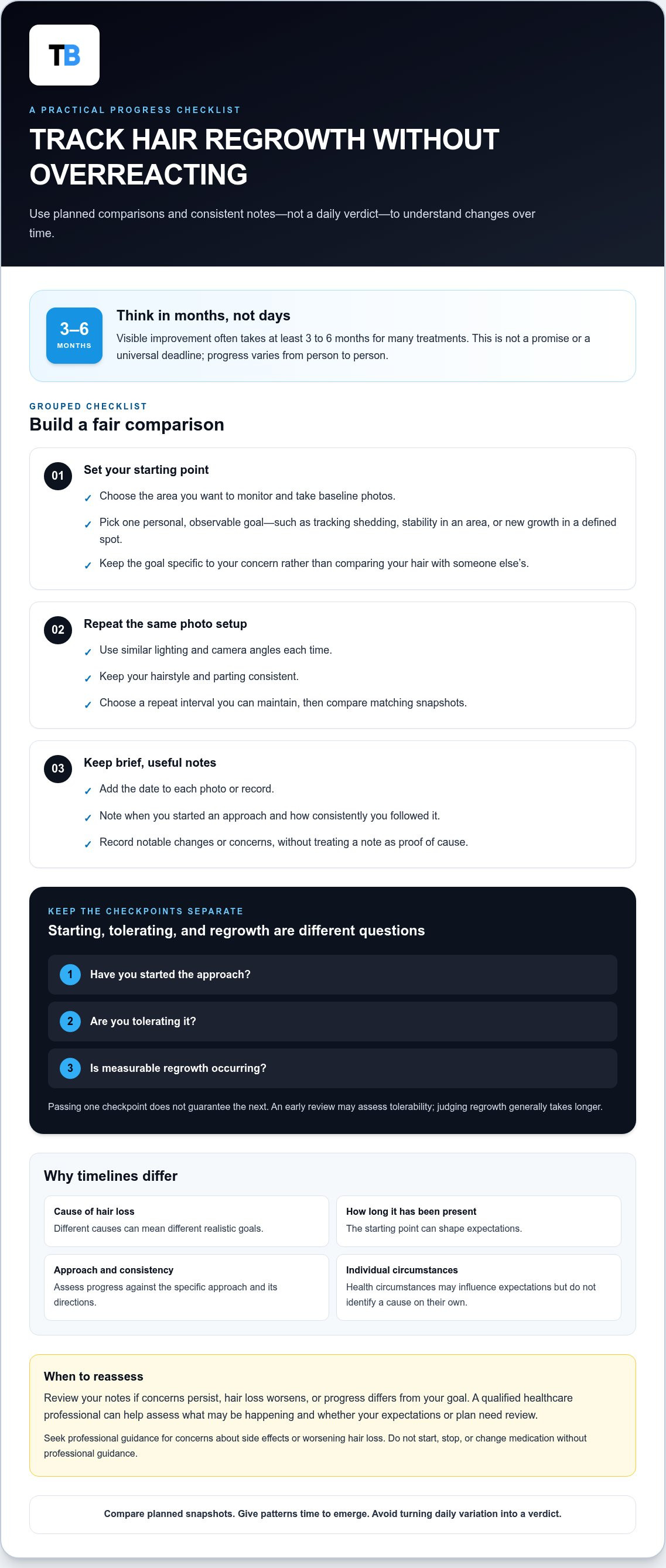
How to Track Hair Regrowth Progress Without Overreacting
A useful record makes comparisons fair. Choose a schedule you can maintain, establish a baseline, and return to it at planned intervals rather than checking for a verdict every day. Consistent tracking helps you notice patterns; it can’t prove what caused a change or predict what will happen next.
A simple routine for comparing changes
At baseline, take photos of the areas you want to monitor. Repeat the same setup each time: use similar lighting and camera angles, and keep your hairstyle and parting consistent. Add the date and brief notes about your routine, including when you started an approach and how consistently you’ve followed it.
- Choose a repeat interval you can maintain.
- Compare photos from matching angles and conditions.
- Note notable changes or concerns, but don’t treat a note as proof of cause.
A single photo can be affected by lighting, positioning, or styling. Shedding can fluctuate from one day to another, too. Consistent tracking compares planned snapshots; daily mirror checks can turn normal variation into a verdict. Give your record enough time to show a pattern before drawing conclusions.
When to revisit your expectations
Review your notes if concerns persist, hair loss worsens, or your progress differs from the goal you set. A qualified healthcare professional can help assess what may be happening and whether your expectations or plan need review. If a clinician identifies a health concern, such as low iron, discuss the appropriate next step with them. Don’t start, stop, or change medication without professional guidance.
Managing expectations for hair regrowth means comparing evidence over time, then acting on sustained patterns rather than daily fluctuations. For a consistent routine, explore TRU BLOOM hair growth options.
Choosing a Next Step: Evidence, Patience, and TRU BLOOM
A clear next step follows a simple sequence: identify what concerns you, choose a realistic goal, then evaluate an approach that fits that goal. Keep the cause of hair loss and the evidence for the specific product in view. A claim about one product shouldn’t be assumed to apply to every item in a range.
How to think about product evidence and personal results
Only TRU BLOOM Hair Growth Vitamins are Clinically Proven. The TRU BLOOM Hair Thickening Spray is not Clinically Proven. Evaluate each product on its own terms, rather than applying one product’s claims to another. TRU BLOOM’s products are designed for fuller, thicker hair in 60 days. That product timeframe doesn’t mean everyone will get the same result by then.
Managing expectations for hair regrowth means taking a product’s evidence seriously while recognizing that individual results can differ. Don’t treat a timeframe in marketing as a substitute for your own progress record or professional guidance. If concerns persist or hair loss worsens, discuss your situation with a qualified healthcare professional.
A measured next step
Keep tracking consistently and review your observations against the goal you set. If you’re considering TRU BLOOM Hair Growth Vitamins, assess the claim for that specific product rather than generalizing across the range. TRU BLOOM offers a 100-day risk-free money-back guarantee.
If you’d like to explore the brand’s hair-growth options, explore TRU BLOOM.
Make Your Next Hair-Growth Decision With Confidence
Make your next move one you can reassess. Decide what information matters to you, choose an approach that fits your personal goal, and give yourself room to evaluate it thoughtfully. Managing expectations for hair regrowth doesn’t require certainty about the outcome. It means making an informed choice and staying attentive to how your needs evolve.
Before choosing a product, read its information carefully and consider whether it aligns with your priorities. Base your decision on what’s documented for that specific option, rather than assuming similar products have identical evidence or results. If you have ongoing concerns, a qualified healthcare professional can help you decide what to consider next.
Explore TRU BLOOM Hair Growth Vitamins and take the next step with a clear goal and a consistent way to track progress.
Frequently Asked Questions
How long does hair regrowth usually take?
Hair regrowth often takes several months to assess, and the timeframe depends on the cause and chosen treatment. Changes may be difficult to detect in the first weeks because new growth needs time to become noticeable among existing strands. For managing expectations for hair regrowth, follow the timeframe recommended for the specific approach and review progress at planned checkpoints instead of expecting a universal deadline.
Is it normal to see little or no hair regrowth at first?
Yes, little or no visible change early on can be normal. A short period may not reveal whether an approach is working. Check that you’re following product directions, and note any side effects or changes. Avoid starting several new interventions at once, since that can make it harder to understand what changed. Seek professional advice if hair loss is sudden or worsening.
Can hair regrow after every type of hair loss?
No, regrowth isn’t possible or predictable for every cause of hair loss. Some shedding may resolve after its trigger is addressed, while other types need specific assessment and may have limited regrowth. A healthcare professional can consider your history and hair-loss pattern, then help clarify whether your practical goal is regrowth, stabilizing further loss, or another outcome.
What should I do if I see no change after 60 days?
No change after 60 days doesn’t automatically mean a product has failed, and a 60-day product timeframe doesn’t mean everyone will have the same result by then. Compare your baseline with consistent records and review whether you’ve followed the product directions. If you remain concerned, discuss the cause and expected timeframe with a qualified healthcare professional before changing your approach.
Should I take hair growth vitamins to manage hair loss?
Hair growth vitamins may be an option, but they aren’t a universal answer to hair loss. Different causes call for different considerations, and taking a supplement without a known need may not address yours. Review the ingredients and directions, and discuss suitability with a healthcare professional, especially if you have a health condition, follow a restricted diet, or take medication.


Leave a comment (all fields required)