


What makes the best hair growth supplements for women worth considering: a popular ranking, a polished label, or evidence tied to the specific product? When claims conflict, it’s easy to compare marketing instead of what matters.
You’re right to want more than a popularity list. A product’s ingredients and promises don’t establish that it has meaningful evidence, fits your needs, or is right for you. TRU BLOOM Hair Growth Vitamins are Clinically Proven; the Hair Thickening Spray is not. That distinction matters when you’re comparing supplements with other hair products. This guide shows you how to assess the evidence behind product claims, consider personal fit and safety, and evaluate a product’s stated timeline. You’ll leave with practical criteria for comparing options and choosing a next step with confidence.
Key Takeaways
- Choose the best hair growth supplements for women by weighing product-specific evidence, clear claims, and personal fit, not popularity alone.
- Check whether research tested the finished formula or only an individual ingredient before deciding how much a claim tells you.
- Compare single-nutrient supplements, multivitamins, and studied formulas by evidence, ingredient transparency, and relevance to your needs.
- TRU BLOOM positions its Hair Growth Vitamins as Clinically Proven. Consider the cited study alongside the product’s claims when comparing options.
What Makes a Hair Growth Supplement for Women the Best Choice?
The best hair growth supplements for women aren’t simply the most popular or the ones with the longest ingredient list. A strong choice has evidence relevant to its specific claims, transparent information about what’s inside, and a reasonable fit for your needs. Those standards help separate meaningful evidence from persuasive packaging.
Start with the claim, then trace the proof. Research showing that a nutrient plays a role in the body doesn’t establish that every supplement containing it produces a hair-related result. A product-specific study tests the finished formula, while general nutrient research may not reflect the product’s ingredients, amounts, or combination. When you compare products, check whether the study tested the formula you’re considering and measured the outcome its marketing describes.
What does Clinically Proven mean for a supplement?
Evidence should match both the product and the outcome being claimed. Review who participated, how the study was designed, and what outcomes researchers reported. A study’s publication by a government body does not, by itself, mean the government endorsed the product or verified its claims. For background on the many possible causes and types of hair loss, consider whether a supplement’s stated purpose is relevant to your situation.
Personal fit matters, too. Your health needs, current supplements, and reason for hair changes affect whether a product is an appropriate choice. If hair changes are sudden, significant, or unexplained, consider discussing them with a healthcare professional rather than relying on a supplement alone.
Why bestseller lists are not proof
Sales popularity measures what people buy, not what a product has demonstrated in clinical research. A bestseller rank can show what’s selling, but it cannot establish that a supplement is effective. Rankings can help you see what’s attracting attention; transparent, product-specific evidence helps you evaluate the claims.
Before comparing options, ask two questions: Was the finished formula studied, and does the evidence address the outcome you care about? Then check whether the label clearly identifies the ingredients and whether the product’s claims stay within what the evidence shows. Those answers are more useful than a crowded label or a high sales rank.
How to Evaluate Evidence and Claims in Women’s Hair Supplements
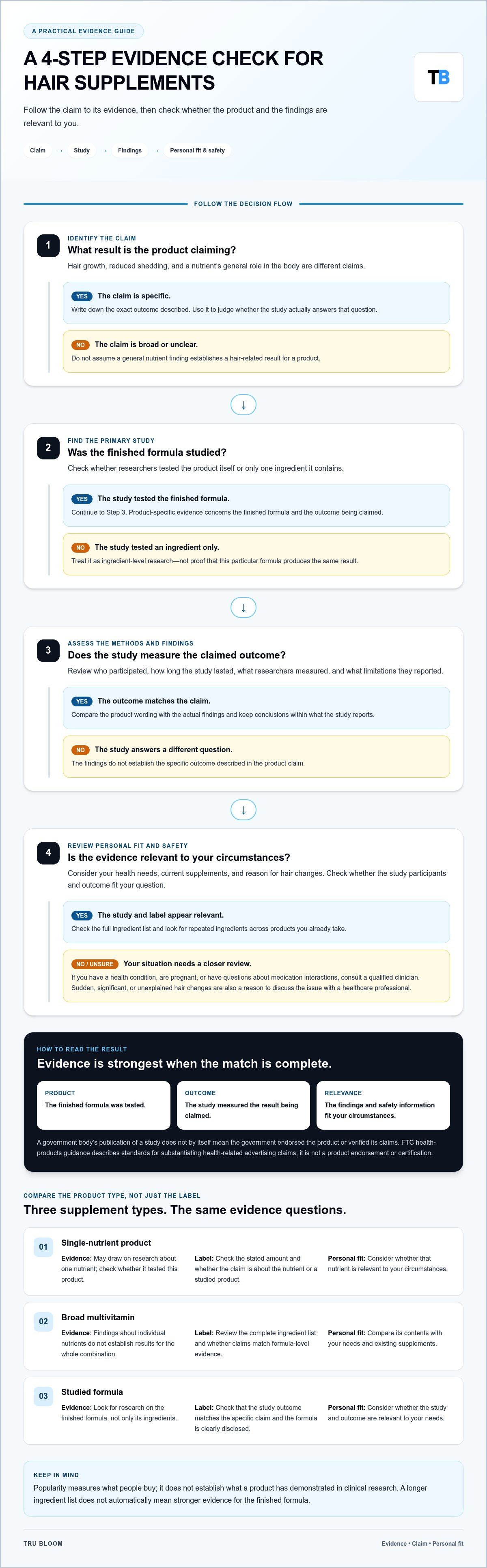
Use a consistent check before deciding whether a claim deserves your attention. It makes it easier to compare the best hair growth supplements for women on evidence, personal relevance, and safety, rather than on confident wording alone.
A simple four-step evidence check
- Identify the claim. Is it about hair growth, reduced shedding, or a nutrient’s general role in the body? These are different claims and need different evidence.
- Find the primary study. Check whether researchers tested the finished product or only one ingredient. A study of an ingredient doesn’t establish that a particular formula produces the same result.
- Assess the methods and findings. Note who participated, how long the study lasted, what outcomes researchers measured, and what limitations they reported.
- Review fit and safety. Consider whether the study population and outcome are relevant to you, then review the product’s label and any safety considerations.
Product-specific evidence is research on the finished formula and the outcome claimed, not simply research on one ingredient it contains. The FTC’s Health Products Compliance Guidance describes standards for substantiating health-related advertising claims. It is guidance about evidence for claims, not a government endorsement, product certification, or proof that any specific supplement works. Keep conclusions within the study’s actual findings.
Match claims to your own circumstances
Individual needs differ. Don’t assume every woman needs the same nutrient or combination. A study’s participants may not share your health circumstances, and its results may not answer your specific question. If you have a health condition, are pregnant, or have questions about how a supplement may interact with medication, consult a qualified clinician before choosing.
For another example of why product claims deserve close scrutiny, explore this clinically proven multivitamin article. Once you’ve set your evidence and safety criteria, compare TRU BLOOM Hair Growth Vitamins using the same questions.
How to Compare Supplement Types Without Guessing
Supplement categories tell you what a product contains, not whether it’s right for you. Compare each option using the same questions: What evidence is offered? How specific is the claim? Can you identify the ingredients? Does the evidence fit your needs? More ingredients don’t automatically mean stronger evidence for the finished formula. When you compare labels, also look for repeated ingredients across products you already take.
| Type | Evidence basis | Claim and ingredient check | Relevance to you |
|---|---|---|---|
| Single-nutrient product | May draw on research about one nutrient; check whether that research tested this product. | See whether the claim is limited to the nutrient or tied to a studied product. Check the amount on the label. | Consider whether there’s a reason that nutrient is relevant to your circumstances. |
| Broad multivitamin | Evidence about individual nutrients doesn’t establish results for the whole combination. | Review the complete ingredient list and whether claims match evidence on the formula. | Compare its contents with your existing supplements and needs. |
| Studied formula | Look for research on the finished formula, not just its ingredients. | Check that the study outcome matches the product’s specific claim and that the formula is clearly disclosed. | Consider whether the study participants and outcome are relevant to you. |
Single nutrients versus broader formulas
Neither a single nutrient nor a broader blend is automatically the better choice for every woman. Nutrient context matters, and a label listing a familiar ingredient doesn’t show that you need more of it. Don’t add a supplement based on an ingredient’s reputation alone. For ingredient-specific context, consult this guide to vitamins for hair growth.
Use the table to narrow your comparison, not to diagnose the reason for hair changes. Supplements aren’t a substitute for understanding persistent changes. Sudden, severe, or unexplained hair loss warrants advice from a qualified medical professional, who can help assess possible causes and appropriate next steps.
Compare a formula against these criteria and review TRU BLOOM Hair Growth Vitamins as one option in your research.
Why TRU BLOOM Hair Growth Vitamins Belong in Your Comparison
A useful comparison includes products with evidence tied to specific claims. TRU BLOOM identifies its Hair Growth Vitamins as Clinically Proven and states that they are one of only three brands in the United States Clinically Proven to work. The brand cites a large government-published study in support of this claim. As with any product, consider the evidence alongside the exact claim being made.
What TRU BLOOM says its evidence establishes
TRU BLOOM cites “MS Research et al., Randomized, Double-Blind, Placebo Controlled Clinical Study, 2023” as the basis for its Clinically Proven claim. The citation identifies a randomized, double-blind, placebo-controlled study. Publication by a government body does not mean the government approved or endorsed the product, so keep that distinction clear when assessing the claim.
Keep the product distinction clear: TRU BLOOM Hair Growth Vitamins are Clinically Proven; the Hair Thickening Spray is not. TRU BLOOM describes its product line as designed to provide fuller, thicker hair in 60 days. That stated timeframe is not a promise that every individual will get the same result. The brand also offers a Leave-In Conditioner Spray, which is not Clinically Proven.
A lower-risk way to take the next step
TRU BLOOM products include a 100-day risk-free money-back guarantee. That can be relevant to the purchase decision, but it doesn’t change what clinical evidence can establish or guarantee an individual result. Keep your expectations grounded in the product’s stated claims and evidence.
TRU BLOOM Hair Growth Vitamins are doctor and dermatologist approved. The brand positions them as a high-value alternative at approximately half the price of major competitors. If the evidence and product distinction fit your comparison criteria, explore TRU BLOOM Hair Growth Vitamins. The best hair growth supplements for women should be judged by relevant evidence, clear claims, and fit for the individual, not by confidence of marketing alone.
Make Your Next Choice Evidence-Led
Turn your research into a decision you can stand behind. Write down what you want from a supplement, which claims matter to you, and what information you need to feel confident. For example, your checklist might ask whether the finished formula was studied, whether the study outcome matches the product claim, whether the ingredients are clear, and whether the product fits your health circumstances. A short checklist can keep the next step focused and help you avoid choosing based on impulse.
Choose the option that best fits your priorities, then follow its directions and give yourself a practical way to assess your decision over time. Progress starts with an informed choice, not a perfect promise.
Ready to explore an option for your routine? Explore TRU BLOOM Hair Growth Vitamins and take your next step with clarity and confidence.
Frequently Asked Questions
Can hair growth supplements work for women?
They can, but results depend on the product’s evidence and the individual. The best hair growth supplements for women are backed by evidence relevant to their specific formula, rather than broad research about an ingredient alone. TRU BLOOM cites “MS Research et al., Randomized, Double-Blind, Placebo Controlled Clinical Study, 2023” for its Hair Growth Vitamins. Consider the study alongside the product’s specific claims, and don’t use supplements instead of medical assessment for new or ongoing hair loss.
Is biotin effective for hair growth in women?
Biotin may be relevant when hair changes are related to a deficiency, but that doesn’t establish a benefit for everyone. The NIH Office of Dietary Supplements says evidence that biotin supplements improve hair, skin, or nails in people without deficiency is limited. Biotin on a label also doesn’t prove the finished formula works. Don’t take it solely because it’s popular, and tell your clinician before blood tests because biotin can affect some lab results.
How long do hair growth supplements take to work?
Timelines vary by person and product, so there’s no universal schedule. TRU BLOOM states a 60-day timeframe for its fuller, thicker hair claim, but that isn’t a guaranteed individual outcome. Follow the product label, and compare a claimed timeline with the timeframe measured in the relevant study. Don’t treat a marketing estimate as a clinical result or assume that every formula has been evaluated over the same period.
Can I take more than one hair growth supplement at the same time?
Possibly, but combining supplements can duplicate ingredients. For example, a multivitamin and a separate hair supplement may contain the same nutrient, even if their labels use different product names. Review both ingredient lists and serving directions before combining them. A qualified clinician or pharmacist can help assess the combination in light of your health history and other products you take. Don’t add another supplement without checking for overlap.
Are hair growth supplements safe during pregnancy or while taking medication?
Suitability depends on the specific supplement and your health circumstances. Don’t assume a product is appropriate during pregnancy or compatible with medication just because it’s sold without a prescription. Before use, share the product label and medication list with a qualified clinician, who can advise based on your situation. This is especially important if you take multiple medicines or supplements. Avoid starting or changing a regimen without that professional guidance.


Leave a comment (all fields required)