


A popular ingredient isn’t proof that a formula can grow hair. If you’re choosing the best hair growth supplement, ask whether evidence applies to the finished formula, not just one familiar ingredient.
Confident claims and long ingredient lists can make products hard to compare. Use a consistent checklist: examine formula-specific evidence, read the label and safety information, and consider whether the product fits your needs. This helps separate useful details from popularity and hype.
TRU BLOOM Hair Growth Vitamins are Clinically Proven and are one of only three brands in the United States with hair growth vitamins Clinically Proven to work. This claim applies to the vitamins, not TRU BLOOM Hair Thickening Spray. This guide explains what to consider when assessing research, why results may depend on whether a deficiency is present, and when to seek medical advice about hair loss. TRU BLOOM also offers a 100-day risk-free money-back guarantee, without promising the same result for every person.
Key Takeaways
- Choose the best hair growth supplement by weighing formula-specific evidence, safety information, and personal fit, not packaging or popular ingredients.
- When reviewing a study, check who took part, what the formula was compared with, how long it lasted, and what outcomes researchers measured.
- Use a simple checklist to distinguish research findings from testimonials and marketing claims before deciding whether a supplement fits your needs.
- TRU BLOOM Hair Growth Vitamins are Clinically Proven. Assess that claim alongside your own needs, and distinguish the vitamins from the Hair Thickening Spray.
What Makes a Hair Growth Supplement the Best Choice?
The best hair growth supplement has evidence relevant to its intended use, clear claims, and safety information that helps you decide whether it fits your needs. A polished package and familiar ingredients may catch your attention, but neither proves that the finished formula has been tested or produces a measured result.
Separate general nutrition information from evidence about a specific product. Knowing that a nutrient plays a role in normal body functions does not establish that taking more of it changes hair growth. More relevant evidence connects a specific formula to defined outcomes in people and explains who was studied, what changed, and what the findings can and cannot show.
Why ingredient lists alone cannot identify a winner
Research on one nutrient does not automatically validate every supplement that contains it. The amount, combination of ingredients, and population studied all matter. Biotin is one example: supplementation may be relevant when someone has a deficiency, but evidence for broad hair-growth claims is limited in people without one, and biotin deficiency is rare. High-dose biotin can also interfere with some lab test results, so tell a healthcare professional about supplements you take before testing.
A popular ingredient is not proof that a complete formula is effective. Compare evidence for the finished product with claims based only on individual ingredients or general nutrition facts.
When thinning hair calls for a medical conversation
Supplements cannot identify why hair is thinning, and they should not replace an assessment of possible causes. Hair changes may relate to factors that need a different response, including an underlying health issue or a nutrient deficiency. A qualified healthcare professional can help determine what evaluation makes sense. For context, Minoxidil, an FDA-approved hair loss treatment, is a medication, not a dietary supplement.
Arrange a medical conversation if hair loss is sudden, persistent, or concerning to you. That can help clarify whether a supplement is appropriate, whether testing is warranted, or whether another approach deserves consideration.
How to Tell Whether a Hair Growth Supplement Is Clinically Proven
Evidence comes in different forms. To judge whether a product claim is meaningful, identify what was studied: an individual nutrient, people using a product in everyday life, or the finished formula in a controlled study. A study of the finished formula is more directly relevant than an ingredient list because it examines the product itself, not just one component.
| Evidence type | What it can tell you | What it can’t establish alone |
|---|---|---|
| Ingredient research | Whether a nutrient has been studied for a biological role or a specific outcome. | Whether the full formula works as claimed. |
| Observational evidence | What researchers observed among people using a product or reporting an outcome. | Whether the product caused the change; other factors may matter. |
| Controlled study of the finished formula | How the specific product performed against a comparison group on measured outcomes. | Whether every person will have the same result or whether findings apply to everyone. |
What to check in a study behind a product claim
Start with a traceable study citation. Check who took part, what the comparison group received, how long the study ran, and which outcomes researchers measured. Then consider whether those participants and outcomes relate to the product’s stated purpose. Hair loss has different causes, as outlined in Causes of hair loss according to Mayo Clinic, so the study population matters. Read the limitations as well. Do not treat a claim about a study’s publisher, participants, or findings as established without a verifiable citation.
What Clinically Proven means for TRU BLOOM Hair Growth Vitamins
TRU BLOOM Hair Growth Vitamins are Clinically Proven, based on a government-published clinical study. The claim applies only to the vitamins, not the Hair Thickening Spray. Clinical evidence is not a promise that every buyer will have the same result. Keep that distinction in mind as you assess what makes the best hair growth supplement for your needs.
For more information about the vitamins, Explore TRU BLOOM.
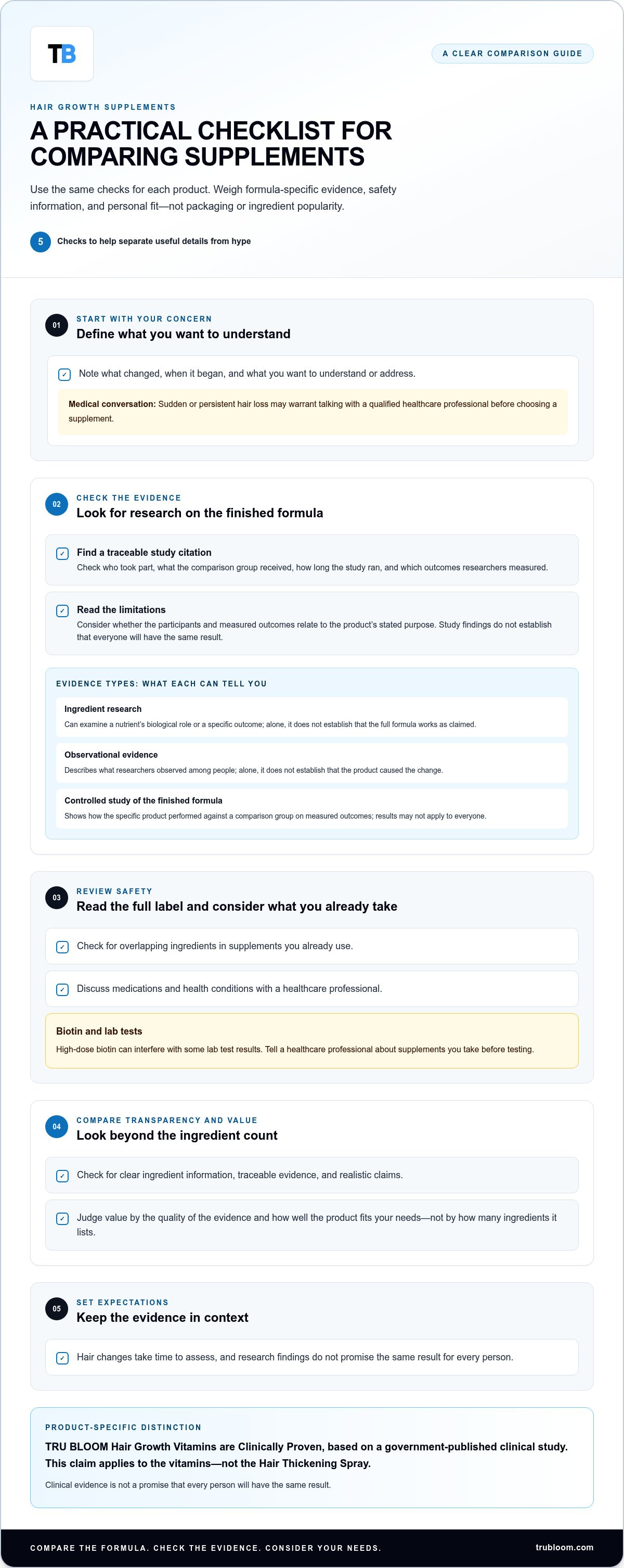
How to Compare Hair Growth Supplements: A Practical Checklist
Use the same steps to compare each product. This makes it easier to weigh evidence, safety, and fit rather than letting packaging or familiar ingredients decide for you. The best hair growth supplement is a considered choice, not simply the most popular bottle.
- Define your concern. Note what changed, when it began, and what you want to understand or address. Sudden or persistent hair loss may warrant a medical conversation before choosing a supplement.
- Review formula-specific evidence. Check whether a study examined the finished formula. Separate measured outcomes from ingredient research, testimonials, and broad marketing claims.
- Assess safety. Read the full label and check for overlapping ingredients in supplements you already take. Discuss medications and health conditions with a clinician. Biotin can interfere with some lab tests, so mention it before testing.
- Compare transparency and value. Check for clear ingredient information, traceable evidence, and realistic claims. Judge value by the quality of the evidence and how well the product fits your needs, not by ingredient count alone.
- Set realistic expectations. Hair changes take time to assess, and individual results can vary. Choose based on evidence and fit, not a promise of a particular outcome.
Match the evidence to your situation
A study’s participants, measured outcome, and duration shape what its results mean. Consider whether the people studied and the changes measured relate to your concern and circumstances. A result in one population may not predict an individual response. Keep personal factors in mind when comparing products intended for different needs.
Check safety and realistic expectations
Review serving directions, ingredients, and cautions on the label. If you take medication, have a relevant health condition, or use multiple supplements, discuss the combination with a qualified clinician. Testimonials are not a substitute for controlled evidence, and a popular ingredient is not automatically right for you.
Apply this checklist to TRU BLOOM Hair Growth Vitamins as you weigh evidence, safety, and personal fit.
Is TRU BLOOM the Best Hair Growth Supplement for You?
TRU BLOOM Hair Growth Vitamins may be worth considering if you want to weigh a formula-specific clinical claim against your needs and health circumstances. No supplement is the right choice for everyone. Review the evidence, read the label, and consider whether a clinician’s input would help you make a decision.
The Clinically Proven claim applies only to TRU BLOOM Hair Growth Vitamins. TRU BLOOM Hair Thickening Spray is not Clinically Proven. Evidence for one product should not be treated as evidence for another.
What the brand’s 60-day claim does and does not promise
TRU BLOOM’s product line is designed for fuller, thicker hair in 60 days. That timeframe describes the brand’s stated product goal, not a guaranteed personal result. Consider the evidence behind the claim and the outcomes measured. Individual results vary, and a stated timeframe cannot predict exactly what will happen for you.
A simple decision rule before you buy
Choose a supplement only if its evidence relates to your concern, its safety information is clear, and its claims are transparent. Consider your health circumstances and any medications, and discuss questions with a qualified healthcare professional. If hair loss is sudden, severe, or unexplained, prioritize professional assessment over self-diagnosis or trying to identify the cause with supplements alone.
If the formula and its evidence fit what you need, Explore TRU BLOOM Hair Growth Vitamins. TRU BLOOM’s 100-day risk-free money-back guarantee gives you a defined period to decide whether the product is right for you.
Make Your Next Step Evidence-Led
Hair changes are personal, so base your next step on what you can verify and what fits your health needs. Before choosing the best hair growth supplement, review the product evidence and label, and consider whether a clinician’s input would help you decide.
TRU BLOOM Hair Growth Vitamins are Clinically Proven based on a government-published clinical study. Give any health-related claim careful attention: examine what the study measured, who participated, and what its limits were. That context helps you make a decision based on more than an appealing promise.
There’s no need to rush or expect one product to be right for everyone. Make a deliberate choice, keep expectations realistic, and seek professional guidance if your hair changes concern you.
Frequently Asked Questions
Do hair growth supplements actually work?
They may help in some cases, particularly when a clinician identifies a relevant nutrient deficiency, but they do not address every cause of thinning. The best hair growth supplement is not automatically effective just because it contains familiar nutrients. Check whether evidence relates to the complete formula and a concern like yours. If shedding persists or changes suddenly, seek advice about its cause instead of adding products blindly.
How do I know if a hair growth supplement is Clinically Proven?
Look for a traceable study that tested the finished formula, not just one ingredient. Check who participated, what the comparison group received, how long the study lasted, which outcomes were measured, and what limitations the researchers reported. TRU BLOOM Hair Growth Vitamins are Clinically Proven based on a government-published clinical study. This claim applies to the vitamins, not the Hair Thickening Spray.
Can biotin help hair grow if I do not have a deficiency?
Evidence that biotin improves hair growth in people without a deficiency is limited, and biotin deficiency is rare. Taking more is not automatically better. High-dose biotin can interfere with some laboratory test results, so tell your healthcare professional if you take it before having bloodwork. If you’re concerned about deficiency, ask whether an assessment is appropriate rather than assuming a supplement is needed.
Are hair growth supplements safe to take every day?
Daily use depends on the specific product, its label directions, and your health circumstances. Check whether a multivitamin or another supplement already contains the same nutrients, since combining products can raise your total intake. If you take medication, have a health condition, or are unsure about an ingredient, review the label with a qualified healthcare professional before starting daily use.
How long does it take to see results from a hair growth supplement?
There’s no single timeline that applies to everyone, and a product’s stated timeframe cannot predict your personal result. Hair changes are gradual, so avoid judging a supplement from day-to-day variation. Follow the label and compare changes consistently over time. If hair loss worsens, begins suddenly, or remains unexplained, consult a qualified healthcare professional instead of simply extending or adding supplements.
Explore TRU BLOOM Hair Growth Vitamins and review the formula, clinical evidence, and 100-day risk-free money-back guarantee to decide whether they fit your needs.


Leave a comment (all fields required)