


The cheapest hair-loss option can become a costly detour if it targets the wrong cause. Affordable hair loss solutions that work start with matching the option to the concern, then weighing evidence, time, and the commitment involved. A persuasive testimonial can’t tell you whether a product is effective for your situation.
It’s understandable to hesitate when the cause is unclear and results may take time. This guide compares practical options, including topical minoxidil, prescription treatments, supplements, and in-office procedures, while keeping their purposes and evidence distinct. You’ll learn what to consider for common patterns of hair loss, how to assess claims beyond marketing, and why value depends on more than the initial price. You’ll also find out when a clinician can help identify the cause and guide your next step. Start with evidence, not hype, and choose a plan you can follow consistently.
Key Takeaways
- Shedding and gradual thinning can have different causes, so identify the concern before choosing a treatment.
- Compare affordable hair loss solutions that work by evidence, intended purpose, suitability, and the commitment required.
- Use a value checklist to review product evidence, directions, and routine length instead of relying on testimonials or unverified savings.
- TRU BLOOM Hair Growth Vitamins are described as Clinically Proven. Check the study details and product suitability, and distinguish them from the Hair Thickening Spray.
Affordable hair loss solutions that work start with the cause
Noticing more hair in your brush or a widening part can be stressful. But a low price alone doesn’t make an option good value. Affordable hair loss solutions that work are options whose evidence and intended use fit the concern, and whose routine and cost you can realistically maintain.
Shedding and gradual thinning aren’t the same pattern, and neither one identifies a cause on its own. Hair changes can relate to hereditary patterns, temporary shedding, or nutrient deficiencies, among other factors. This overview of the causes of hair loss describes several types. If you’re wondering about iron, don’t assume you have a deficiency. Our article on iron supplements and hair regrowth explores why the cause matters.
An evidence-informed, affordable solution is a treatment or product chosen for a plausible cause, evaluated using evidence relevant to its intended use, and judged by its full commitment rather than its upfront cost. No single option is right for everyone.
When hair loss calls for a clinician
Seek professional assessment for sudden, patchy, persistent, or unexplained hair loss. A clinician can review your health history and decide whether testing is appropriate. That can help clarify which options make sense. Supplements can’t identify the cause or address every underlying condition.
Why matching the solution to the cause matters
A product chosen because of a testimonial or broad promise may not fit your situation. Check what was studied, who was studied, and how the product was used. Evidence for one population or use doesn’t establish that the same option will work for another cause. Match the claim to the evidence, then check suitability before committing to a routine.
Compare affordable hair loss solutions by evidence and purpose
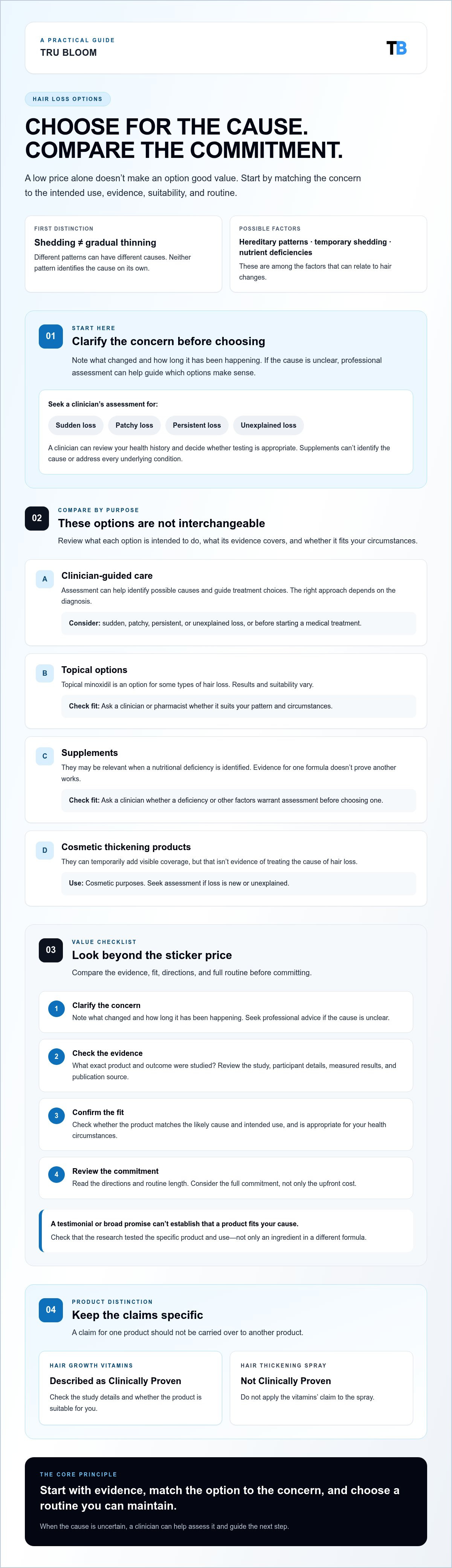
Affordable hair loss solutions that work aren’t interchangeable. Compare what each option is intended to do, what its evidence covers, and whether it fits your circumstances. The American Academy of Dermatology emphasizes accurate diagnosis as a first step. Discuss topical minoxidil with a clinician or pharmacist to check whether it may suit you.
| Category | Purpose and evidence caveat | Fit and when to seek advice |
|---|---|---|
| Clinician-guided care | Assessment can help identify possible causes and guide treatment choices. The right approach depends on the diagnosis. | Consider it for sudden, patchy, persistent, or unexplained loss, or before starting a medical treatment. |
| Topical options | Topical minoxidil is a treatment option for some types of hair loss. Results and suitability vary. | Ask a clinician or pharmacist whether it fits your pattern and circumstances. |
| Supplements | May be relevant when a nutritional deficiency is identified. Evidence for one formula doesn’t prove another works. | Ask a clinician whether a deficiency or other factors warrant assessment before choosing a supplement. |
| Cosmetic thickening products | Can temporarily add visible coverage, but aren’t evidence of treating the cause of hair loss. | Consider them for cosmetic use. Seek assessment if loss is new or unexplained. |
Medical treatments, supplements, and cosmetic products serve different purposes. For instance, while treatments focus on biological regrowth, aesthetic alternatives like toppers and lace wigs from Rachel Hair provide immediate visual coverage. A testimonial or broad claim can’t establish that a product fits your cause. Ask for the cited study and check who participated, what outcomes were measured, and where it was published. Confirm that the research tested the specific product and use, not just an ingredient in a different formula.
TRU BLOOM describes its Hair Growth Vitamins as Clinically Proven and says its products are doctor and dermatologist approved. Its Hair Thickening Spray is not described as Clinically Proven, so don’t apply the vitamins’ claim to the spray. For a closer evidence review, consult the brand’s Clinically Proven hair growth vitamins guide, then review the TRU BLOOM product information to check whether the vitamins are suitable for you.
Choose an affordable hair-loss option with a value checklist
Sticker price alone can hide the real commitment. To compare affordable hair loss solutions that work, check the evidence, fit, directions, and full routine before buying. Use this checklist:
- Clarify the concern. Note what changed and how long it’s been happening. Seek professional advice if the cause is unclear.
- Check the evidence. What exact product and outcome were studied? Can you review the study, participant details, measured results, and publication source?
- Confirm the fit. Does the product match the likely cause and intended use, and is it appropriate for your health circumstances? Ask a clinician or pharmacist if you’re unsure.
- Review the directions and terms. Check current usage instructions, guarantee conditions, and exclusions before purchase.
- Assess the commitment. Compare verified serving or usage information with the length of routine you’re prepared to maintain. Don’t assume the lowest upfront cost offers the best value.
A guarantee can reduce purchase risk, but it can’t establish clinical effectiveness. TRU BLOOM states that its Hair Growth Vitamins have a 100-day risk-free money-back guarantee, so review the current terms. The company also presents a 60-day hair-results claim. Treat that as a brand claim and check it against current product information and directions. Hair changes take time, and individual outcomes vary. For more product-specific context, consult the published guide to hair growth vitamins and check whether its evidence applies to the product and use you’re considering.
Before buying, use the checklist to compare the product’s evidence, suitability, and terms. Explore TRU BLOOM Hair Growth Vitamins and review the available product information.
Is TRU BLOOM a suitable next step for affordable hair loss care?
A supplement may be worth considering if it fits your needs and you’ve reviewed its ingredients, evidence, and suitability—whether exploring targeted hair formulas or wider wellness supplements from Gara Health. But unexplained, sudden, or persistent hair loss calls for cause-specific assessment first. A supplement can’t identify why hair is changing or address every underlying cause. If you have health concerns or questions about whether a supplement is appropriate for you, ask a clinician.
What the TRU BLOOM claims do and do not establish
TRU BLOOM describes its Hair Growth Vitamins as Clinically Proven and associates them with a government-published study. Before relying on that claim, review the study citation, participants, methods, measured outcomes, and relevance to the product and your situation. Don’t infer specific results without those details. The claim applies to the vitamins only. TRU BLOOM Hair Thickening Spray is not described as Clinically Proven; check its current product information to understand its intended cosmetic use.
The company states that it offers a 100-day risk-free money-back guarantee. Read the current terms, including any conditions or exclusions. A guarantee concerns purchase terms. It doesn’t verify clinical evidence or promise a medical outcome.
A practical next step
Before deciding, check the current ingredient list and directions, look for the cited study, and confirm the guarantee terms. Compare those details with your concern and the commitment you’re prepared to make. If hair loss is unexplained, you have health concerns, or you’re unsure whether a supplement fits your circumstances, get clinician input first.
Choosing affordable hair loss solutions that work means judging evidence and suitability, not relying on a label alone. If you’d like to review the company’s information at your own pace, review TRU BLOOM products and guarantee details.
Choose your next step with confidence
Affordable hair loss solutions that work begin with a sensible match: consider the likely cause, check evidence for the specific product and use, and choose a commitment you can maintain. Shedding and gradual thinning may have different causes, so unexplained or persistent changes deserve professional assessment before you settle on a routine.
TRU BLOOM describes its Hair Growth Vitamins as Clinically Proven and says its products are doctor and dermatologist approved. Review the study details and product suitability before deciding. The Hair Thickening Spray is not described as Clinically Proven, so don’t apply the vitamins’ claim to the spray. TRU BLOOM states that it offers a 100-day risk-free money-back guarantee. Check the terms, and remember that a guarantee concerns purchase risk, not medical outcomes.
Make your decision on evidence and fit, not testimonials or a low upfront price alone. If you’d like to review the products and guarantee terms directly, review TRU BLOOM products and guarantee details. Take the next step at your own pace, with clear information and the right guidance for your needs.
Frequently Asked Questions
What is the most affordable hair loss solution that works?
There isn’t one cheapest solution that works for every cause. The best value depends on whether the issue is pattern thinning, temporary shedding, a deficiency, or something else. For some people with pattern hair loss, generic topical minoxidil may be a relatively low-cost option. Check whether it suits your circumstances with a clinician or pharmacist, and compare evidence and ongoing use, not just the package price.
Can vitamins stop hair loss if I do not have a deficiency?
Vitamins aren’t a guaranteed way to stop hair loss when you don’t have a deficiency. Hair changes can have causes that a supplement won’t address, and evidence for one formula doesn’t prove another works. Don’t assume you need a nutrient supplement based on shedding alone. If you suspect a deficiency or have unexplained loss, ask a clinician whether assessment or testing is appropriate before choosing a product.
Is minoxidil an affordable option for hair loss?
Generic topical minoxidil can be a lower-cost option for some people with pattern hair loss, but it isn’t right for every cause. HairLine AI reported an estimated annual cost of about $100 to $180 at retail pharmacies in July 2026, with some warehouse-club options around $40 to $60. Prices may vary. Ask a clinician or pharmacist whether minoxidil is suitable for you and review current product directions.
How long should I try a hair loss solution before judging results?
There’s no single timeline that applies to every product or cause, and hair changes take time. Follow the product’s current directions and any timeline in relevant clinical evidence. Don’t extend use or change directions based on a testimonial. Track changes consistently, and consult a clinician if loss is sudden, patchy, persistent, or unexplained. Treat a company’s stated results timeframe as a claim to verify, not a guarantee.
Are TRU BLOOM Hair Growth Vitamins Clinically Proven?
Yes. TRU BLOOM describes its Hair Growth Vitamins as Clinically Proven and associates them with a government-published study. Before drawing conclusions, review the study citation, participants, methods, measured outcomes, and relevance to the product and your circumstances. This claim applies to the Hair Growth Vitamins only. TRU BLOOM Hair Thickening Spray is not described as Clinically Proven, so don’t transfer the vitamins’ evidence claim to the spray.


Leave a comment (all fields required)